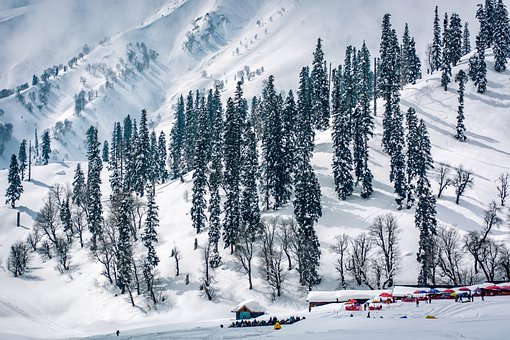
On 20 December, Kashmir witnessed temperatures dipping below the freezing point, a day ahead of the Chilla-i-Kalan, the harshest 40-day harshest winter period. It’s during this period that the cold wave grips the region, and when temperature drops considerably leading to freezing of water bodies, including the well-known Dal Lake, as well as the water supply lines, according to media reports.
On 21 December, Kashmir valley saw the mercury dropping several notches below the freezing point in several places, including Pahalgam, which registered the lowest night temperature at minus 6.2 degrees Celsius, as per the officials. Several places in Kashmir witnessed some of the coldest nights of the season so far. The Dal Lake froze, as well as the water in the taps, according to officials.
Reportedly, Srinagar saw minimum temperature going down minus 4.2 degrees Celsius recently, whereas the famous ski resort of Gulmarg in north Kashmir’s Baramulla district recorded minus 4.6 degrees Celsius.
Further, north Kashmir’s Kupwara saw the mercury settling down to as low as minus 4.4 degrees Celsius, minus 4.2 degrees Celsius in Qazigund, and minus 2.4 degrees Celsius in Kokernag. Dry weather in Jammu and Kashmir will likely continue till December 24, and there is a possibility of rains or light snowfall in some parts of Kashmir around Christmas. There are also maximum chances of snowfall during this period, while most areas, especially in the higher reaches, will be receiving heavy snowfall.
Chillai-Kalan will continue till the end of January, although the cold wave will continue even after that in Kashmir.
In his blog, Moscow Mayor Sergei Sobyanin spoke about the target indicators that were included in the program for the development of tourism in the capital until 2030
Visitors will be able to visit objects in Sochi and Adygea for free - the Laura eco-center in the Krasnaya Polyana village, the Yew-Boxwood Grove in Khosta, the Southern Cultures park on the federal territory of Sirius, Guzeripl and the Lagonaaki checkpoint
Just a blink of an eye ago, the UAE transformed from scattered fishing villages to a futuristic metropolis fueled by oil. Now, the nation is embarking on a crucial mission: preserving its history
Tourism.RF Corporation and GC Abrau-Dyurso have signed an agreement to create the first hotel as part of the development of the Abrau-Dyurso tourist cluster
The official portal "Wild Nature of Russia" reported that the scientific group of the leopard conservation project of the A. N. Severtsov Institute of Ecology and Evolution has published the results of the program to restore this rare cat in the Central Caucasus from 2018 to 2023

 Blogs
Blogs