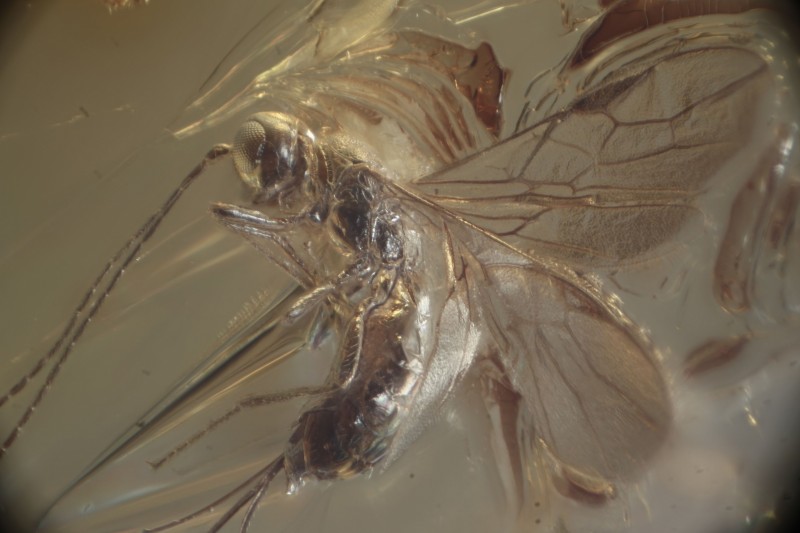
The press service of the Kaliningrad Amber Museum reported that a specimen with a previously unknown ancient species of parasitoid barconid wasps was found in the collection of the institution. In one stone there is both a reference specimen of an insect and a reference specimen of the second order.
Specialists from the Zoological Institute of the Russian Academy of Sciences and the Kaliningrad Amber Museum published an article in the scientific journal Zootaxa, in which they described the new species in detail and compared it with extinct and living insects.
In addition to large real eyes, the insect additionally had three medium-sized eyes on the forehead. In addition, it had antennae 1.2 times the length of its body.
Andranik Manukyan, a researcher at the Amber Museum, said that the described species bears some resemblance to the well-known species of the genus Guaygata from Jamaica, but is radically different in general body structure. Also, probably, the “amber” species had a faster flight, as evidenced by the structure of a kind of wing weight.
The authors of the article believe that the parasitoids were attracted by the smell of fresh resin from the tree where their victims lived. According to scientists, these insects once lived in the "amber" forest and became extinct after its disappearance. Their distant descendants are found only in the tropics.
On the eve of Victory Day and for 10 days after it Moscow Domodedovo Airport invites veterans of the Great Patriotic War departing or arriving at the air harbor to the VIP lounge
According to the Phobos weather center, from April the southern wind will intensify, and a powerful advection of Black Sea air will begin in the continental regions of the country

 Blogs
Blogs